
Kilometer charge: changes planned from January 1, 2027
New rates:
Starting Friday, January 1st, 2027, new rates for the kilometer charge will be applicable:
- For the Brussels-Capital Region:
- no indexation of the rates is planned
- adjustment of the rates for zero-emission vehicles (see below).
- For Flanders:
- a rate indexation (whereas the indexation was previously applied in July, rate indexation in Flanders, if applicable, will henceforth take effect on 1 January of each year).
- adjustment of the rates for zero-emission vehicles (see below).
- For Wallonia (SOFICO): a rate indexation calculated on the basis of the Consumer Price Index for August 2026, in accordance with Article 7(4) of the Walloon Decree of 16 July 2015."
Please refer to the table below for the new rates effective from January 1.
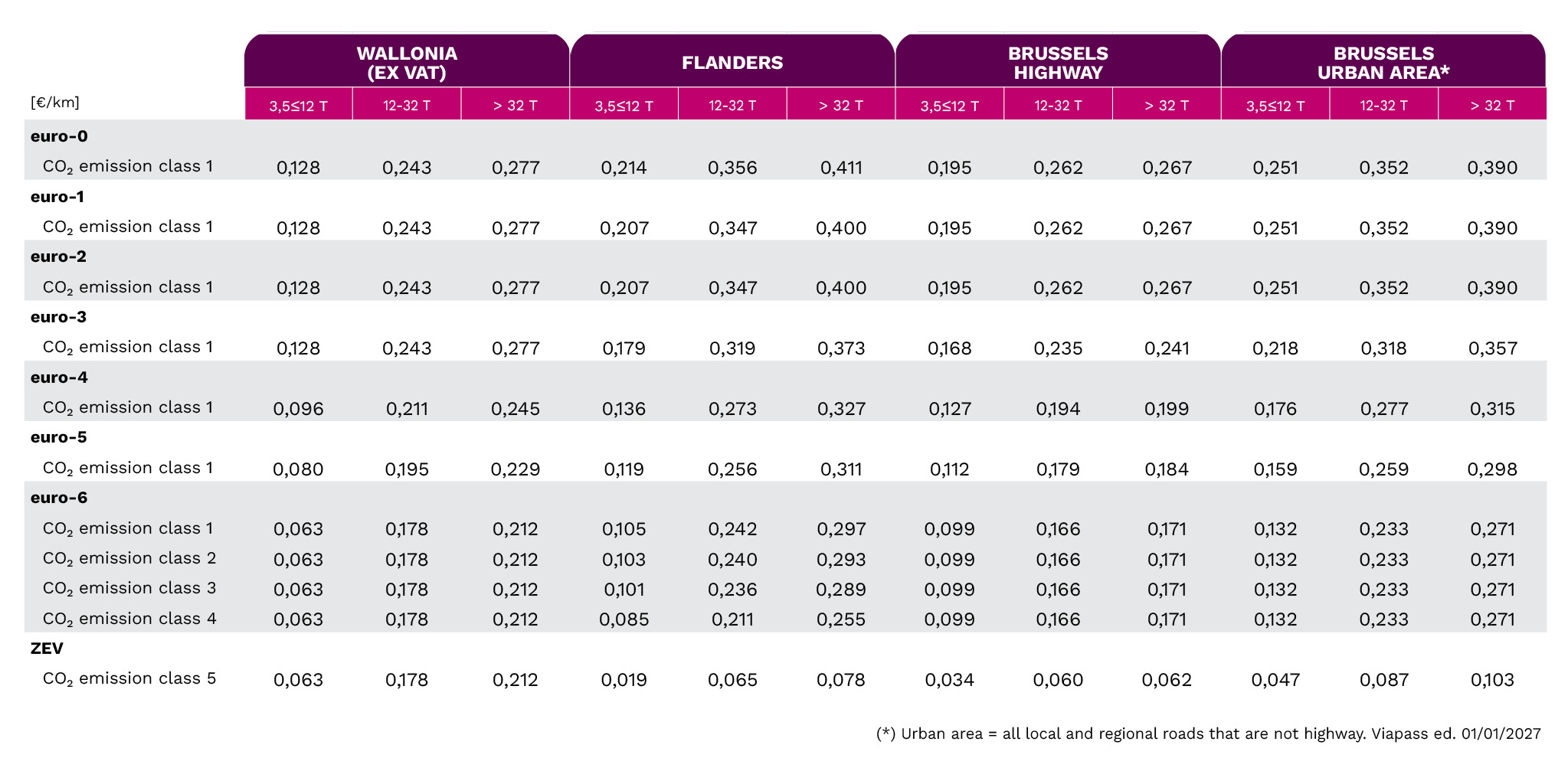
Adjustment of the rates for zero-emission vehicles
As announced in previous communications, the rates for zero-emission vehicles (ZEV) in Flanders and in the Brussels-Capital Region will be adjusted on January 1, 2027.
The rates consist of two types of parameters:
- the parameter related to the external cost charge remains set at zero euro cents until December 31, 2029 (for Flanders and the Brussels-Capital Region).
- the other part (the infrastructure component) of the kilometer charge was reduced by 100% in 2024–2025, by 80% on January 1st, 2026, and will be adjusted to 60% for the year 2027 (planning for the following years: 40% for 2028, and 20% for 2029).
The measures applied were introduced with a view to encouraging the greening of the truck fleet driving on our roads.
Change to the network
No roads with a rate higher than zero will be added at this date.
General information
As a reminder, the rates for the kilometer charge apply to all Belgian and foreign heavy goods vehicles (HGVs) with a gross vehicle weight (GVW) of more than 3.5 tons and semi-trailer towing vehicles of category N1 with body code BC.
The software of activated OBUs (On Board Units) of the seven service providers accredited for the kilometer charge in Belgium will be automatically updated with the new rates that come into force on January 1st. The seven service providers are Axxès, Satellic, Telepass, Toll4Europe, Tolltickets, TotalEnergies Marketing Services and W.A.G. Payment Solutions.
An OBU is a device in the truck cabin that records the number of kilometers driven on paying toll roads. Trucks and semi-trailer tractors of the N1 category with a body code BC registered in Belgium or abroad must always have the OBU switched on when driven on public roads in the three regions.
The amount charged per kilometer on toll roads depends on four factors:
- the region where the road is located,
- the GVW,
- the Euro emission standard of the vehicle,
- the CO₂ emission class.
The kilometer charge applies to three GVW categories (more than 3.5 tons to 12 tons, more than 12 tons to 32 tons, and more than 32 tons), seven Euro standards (from the most polluting Euro 0 standard to the most environmentally friendly Euro 6 standard) and 5 CO₂ emission classes (CO₂ emission classes 1 to 5). In Flanders, a CO₂ emission class surcharge has been applied to the kilometer charge rates since 1 July 2026. The other regions have not, to date, implemented this surcharge.
A preferential rate is granted to zero-emission vehicles (ZEV) on the entire Flemish and the Brussels-Capital Region road network. However, the OBU remains mandatory for ZEV. In Wallonia (SOFICO), ZEV are still classified in the EURO VI emissions category.